
Legal
Legal AI Software for Teams That Cannot Leak
Legal AI software that helps firms and in house teams review documents faster, find the right precedent, and keep privilege intact, grounded in your own matter files rather than a public corpus.
01 Challenges
Legal AI Software Challenges
Legal teams face four recurring problems: matter files scattered, review work, precedent that is hard to surface, and privilege that must survive every tool you
Documents Scattered Across Systems
Manual Review Hours
Precedent Nobody Can Find
Privilege and Confidentiality Risk
Client Data Residency Rules
Citations That Cannot Be Checked
Billable Pressure on Junior Time
Partner Scepticism About AI
02 Solutions
Legal AI Software We Deliver
We deliver document review and summarisation, precedent search, clause extraction, matter intake automation and drafting assistance. Every answer draws on your own matter files.

Key terms, dates, obligations, and deviations extracted into a structured summary, with the source passage attached to every field.
Get StartedSemantic search across your own precedent library and closed matters, so a description of the clause you need returns the drafting that matches it.
Get StartedIncoming drafts compared against your playbook positions, with deviations ranked by materiality rather than listed alphabetically.
Get StartedFirst-pass drafting from your own approved language, appearing inside the document rather than in a separate window you then copy back.
Get StartedHigh-volume data room review with issue lists, red flags, and coverage tracking, so you know what your team has read and what it has not.
Get StartedConflicts inputs, engagement details, and matter data captured from intake documents and written to your practice management system.
Get StartedRenewal dates, notice periods, and reporting obligations pulled from executed agreements into a calendar someone actually owns.
Get StartedGrounded question answering over your internal knowledge and subscribed sources, with a pinpoint citation on every proposition.
Get StartedThe services behind a matter build
Legal AI software leans hardest on retrieval and document workflow. These are the disciplines a matter build draws on.
Business Process Automation
We automate the repeatable parts of a process, from document intake to decisions and handoffs, with an exception path designed before the happy path.
Explore Business Process AutomationAI Consulting
A short discovery that identifies high-impact use cases, reviews your data and systems, and returns a phased roadmap with costs and risks attached.
Explore AI ConsultingAI Integration
We wire AI into the systems you already run, with identity, data, latency and failure behaviour designed before anything ships.
Explore AI IntegrationChatbot Development
Assistants that answer from your own content, hand off cleanly to a person, and log every conversation for review.
Explore Chatbot DevelopmentGenerative AI Consulting
A short engagement that finds where generative AI pays for itself in your business, and where it does not.
Explore Generative AI ConsultingGenerative AI Development
We design and integrate large language model features into your product, with retrieval, evaluation harnesses, and prompt governance in place before launch.
Explore Generative AI Development03 Why KoderTal
Why Choose Us for Legal AI Software?
Legal buyers choose us because confidentiality are design constraints rather than settings. Your matter files stay in your environment & models draw on your own corpus.
04 Client Review
Support did not stop at launch.
Weekly demos during the build, documented decisions, and a support arrangement that has now run for two years past release.
Trustpilot

05 Case Studies
Our Recent Legal AI Software Projects
See how we have built and deployed assistants that changed how legal teams handle document volume
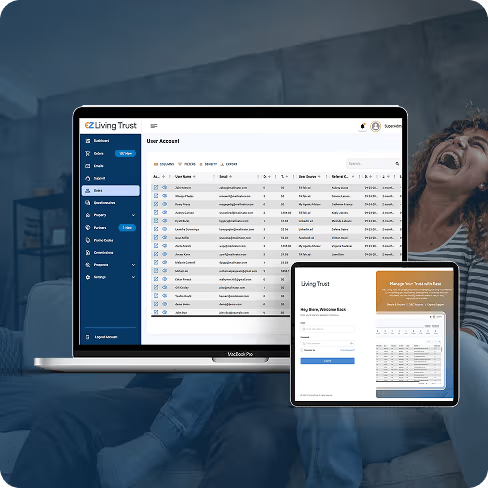
Legal & Estate Planning
Building a Secure, Multi-Portal Legal Platform
A digital estate planning platform running end to end across three portals, simplifying legal documentation and improving transparency for every party to a trust.
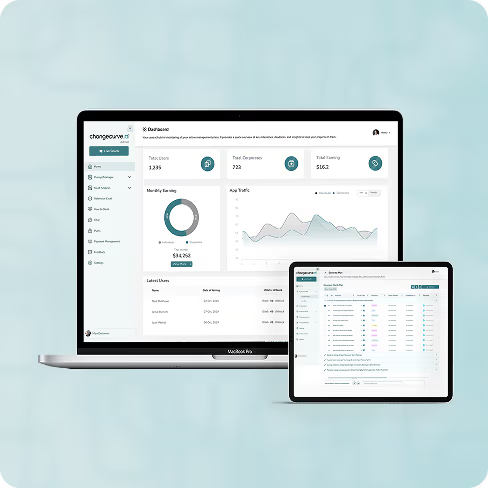
Change Management
AI-Powered Enterprise Change Management for Large-Scale Organizations
Enterprise change management software letting organisations execute, monitor and sustain change faster, with the progress of every initiative visible in one place.
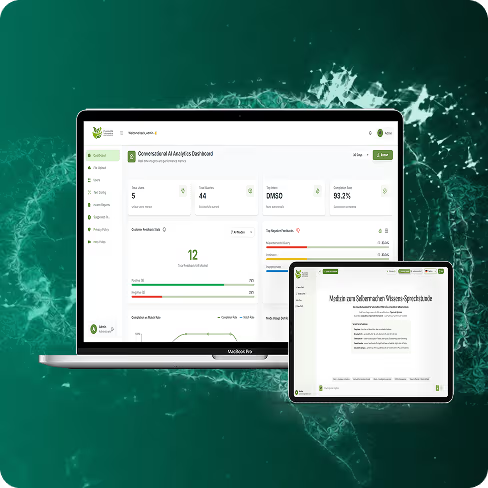
AI Automation
AI-Powered Content Automation Platform
An AI content engine that turns sales and strategy calls into ready-to-post content, matched to the brand's own voice and scheduled straight to LinkedIn.
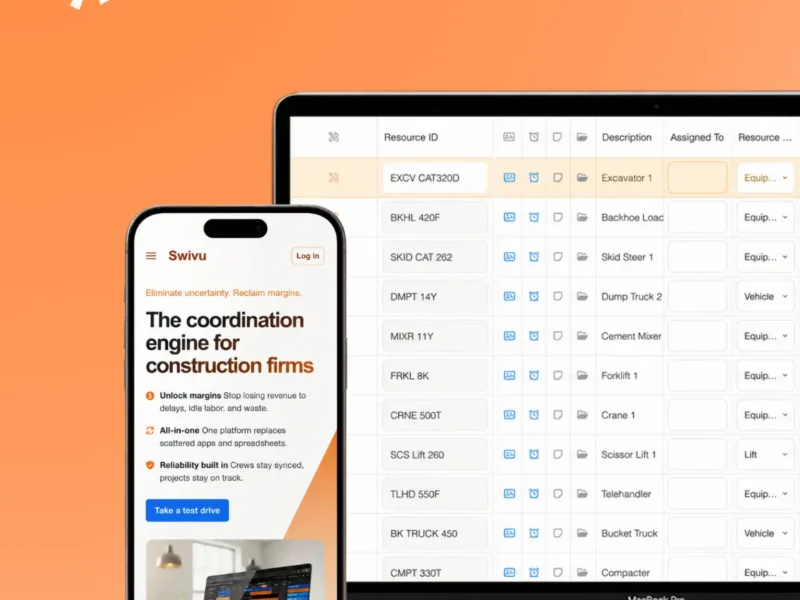
Construction Management
Real-Time Construction Coordination, From HQ to Field
A construction coordination platform for multi site work, replacing spreadsheets and scattered email with tasks, schedules and on site progress synced in real time.
06 Process
Our Legal AI Software Process
A legal build runs in seven steps, from requirements and roadmap through model design, integration, testing and confidentiality review, to deployment and ongoing support.
Get Your Roadmap-
Matter & Workflow Discovery
We start with the practice areas in scope, the documents involved, and where review time actually goes. Our team maps conflicts, ethical wall, and confidentiality constraints alongside the workflow. That produces a scope with the access rules written down before we build anything.
-
Legal AI Strategy & Roadmap
We translate priorities into a phased plan with measurable targets, timelines, and risk controls. The plan covers model choice and processing location, which sources we index, and what supervision each output needs before a fee earner relies on it.
-
Retrieval & Drafting Build
We build the retrieval layer over your approved sources, then the extraction and drafting behaviour on top of it. Evaluation runs against matters your firm has already closed, with pass thresholds agreed per document type and weekly demos on real examples.
-
DMS & Practice System Integration
We integrate with your document management, practice management, and intake systems through scoped API access, inheriting the permissions those systems already enforce. Integrations are staged and reversible, and every output is written back to the matter record.
-
Privilege & Accuracy Testing
We test extraction accuracy, citation correctness, and access boundaries deliberately, including attempts to retrieve across matter walls. We document results for your risk and compliance reviewers, and nothing goes live until the boundary tests pass cleanly.
-
Supervised Rollout
We launch with one practice group, full audit logging, and a rollback path held open. Reviewers see accuracy and time saved against the agreed baseline before you bring on the second group.
-
Precedent Upkeep & Support
We keep the index current as new matters close, update playbook positions as they change, and monitor accuracy and cost after launch. You get systems we document as we build them, and a named team that recalls the reasoning behind each decision.
07 Tech Stack
The Legal AI Software Stack We Use
Proven tools and frameworks, chosen because they hold up against privilege and retention rules.
- OpenAI
- Claude
- Gemini
- Llama 3
- Mistral
- Falcon
- LangChain
- LlamaIndex
- Haystack
- DSPy
- LoRA
- PEFT
- Axolotl
- Unsloth
- Pinecone
- Weaviate
- pgvector
- Qdrant
- Chroma
- OpenAI API
- Anthropic API
- Vertex AI
- Bedrock
- LangSmith
- Langfuse
- Arize
- Helicone
- Guardrails AI
- NeMo Guardrails
- Presidio
- Streamlit
- Chainlit
- Next.js
- Vercel AI SDK
08 FAQ
FAQs
Quick answers to common legal AI software questions before you start your build
Legal AI software protects privilege by keeping matter files in your own environment and grounding models on your corpus rather than a public one. Every answer traces back to a document you can open, so a fee earner can verify a result before relying on it.
The retrieval layer enforces access using the permissions your document system already holds, so it never surfaces a document a user cannot open. We test matter separation and ethical walls explicitly before launch, and the system logs every query for audit.
In most cases yes. We integrate with iManage, NetDocuments, SharePoint, and similar systems through their APIs, inheriting their permission model rather than building a second one. Where an API is limited we index a controlled mirror that carries the same access rules.
Every answer carries the source passage and its location in the document, so verification is a click rather than a re-read. Where the sources do not support an answer, the system reports that instead of producing one, and we test that behaviour deliberately before launch.
Yes. Everything the system produces is a draft with an accept step, and nothing is filed, sent, or executed on the strength of a model alone. The point is to move review from reading everything to checking the exceptions.
09 Book a Call
Ready to Build with KoderTal's AI Experts?
Tell us what you are trying to automate or ship. We reply within one business day with a next step and the engineer who would run the work.
- 2451 West Grapevine Mills Circle, Grapevine, TX 76051 · USA
- hello@kodertal.com
- Reply within 1 business day, 24/7 support once live